What Is the Difference Between Queer and Non-Binary?
The main difference between queer and non-binary is that non-binary specifically describes someone’s gender identity, while queer is a broader term. Queer can refer to gender, sexual orientation, or both. Someone can therefore be both queer and non-binary, but a queer person does not have to be non-binary. Likewise, a non-binary person does not have to identify as queer.
The difference between queer and non-binary is mainly about what the terms describe
Non-binary is about how someone experiences their own gender. A non-binary person does not identify exclusively as a man or exclusively as a woman. What that means personally can differ greatly from one person to another.
Queer is less specific. Some people use queer as a broad identity for their gender, sexuality, or both. Others choose the term precisely because they do not want to define themselves with a more specific label.
Put simply:
- Non-binary describes a gender identity outside, between, or not fully within the male/female binary.
- Queer is a broader term that can refer to gender, sexual orientation, or both.
- Queer and non-binary can overlap, but they do not mean the same thing.
The distinction becomes clearer when you first understand what non-binary means and then look at the broader meaning of queer.
What does non-binary mean exactly?

Non-binary is an umbrella term for gender identities that are not exclusively male or female. That does not mean every non-binary person experiences gender in the same way.
One person may feel both masculine and feminine, while another may feel neither. Someone’s experience of gender may also change over time or fall somewhere between different identities. There are therefore several identities within the non-binary umbrella, but nobody has to choose a more specific label.
Non-binary relates to gender identity: your personal sense of your own gender.
It does not automatically say anything about how someone looks. A non-binary person may present in a masculine, feminine, androgynous, or changing way. Clothing, hair, make-up, voice, or body shape do not determine whether someone is non-binary. You can read more about this in our explanation of non-binary identity and gender expression.
Being non-binary also does not tell you who someone is attracted to. Sexual or romantic orientation describes that separately.
Queer is deliberately a broader term
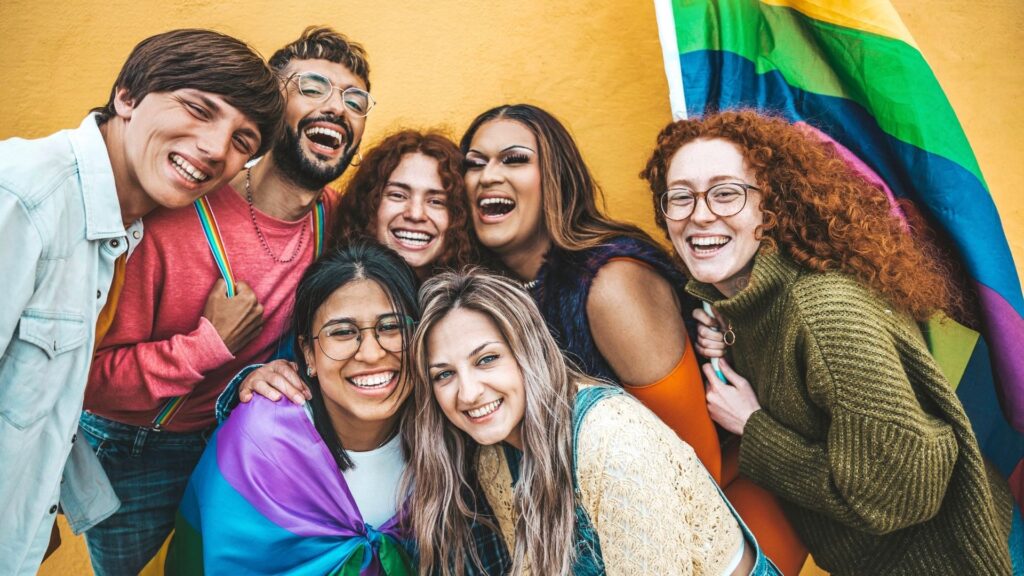
Queer is harder to place inside one clearly defined category. For many people, that flexibility is exactly why the word feels useful.
Someone may use queer as a broad term for a sexual orientation that is not heterosexual, for a gender identity that falls outside traditional expectations, or for a combination of the two. Sometimes a more specific label such as lesbian, bisexual, pansexual, trans, or non-binary may also fit, but queer simply feels more comfortable. People can also use several labels at the same time.
For example, someone might say:
“I’m non-binary and queer.”
In that case, non-binary gives specific information about their gender identity. Queer may describe their gender or sexuality more broadly.
Another person may identify as queer while still identifying fully as a man or a woman. Being queer does not automatically mean being non-binary.
If you want a more detailed explanation, you can read more about what queer means.
Not everyone feels comfortable using queer for themselves. It is therefore better to use the words someone chooses for themselves rather than assigning the label to another person.
Gender identity and sexual orientation are different things
Much of the confusion around queer and non-binary comes from mixing up gender identity and sexual orientation.
Gender identity is about who you are in relation to gender. You may identify as a man, a woman, non-binary, or use another term that fits you better.
Sexual orientation describes who you may experience sexual attraction towards. Romantic orientation similarly describes romantic attraction.
Non-binary therefore belongs specifically to the area of gender identity. Queer can cover several aspects of identity and is less narrowly defined.
Gender expression is something different again. It refers to how someone expresses gender outwardly, for example through clothing, hairstyle, voice, make-up, or behaviour. A particular gender expression does not prove someone’s gender identity or sexual orientation.
If you want to separate these concepts more clearly, our explanation of the difference between gender and sex is a useful next step.
Can you be queer and non-binary at the same time?
Yes. Queer and non-binary do not exclude each other. Someone can use both terms when together they better describe who that person is.
You can think of them as two labels that may communicate different information. Non-binary says something specific about gender identity. Queer can add a broader description of gender, sexuality, or both.
There are no required combinations, though. A non-binary person may also identify as lesbian, gay, bisexual, pansexual, asexual, heterosexual, or use another term. Some people prefer not to use a label for their sexual orientation at all.
The reverse is also true. Someone can be queer without being non-binary. A man who identifies as queer because of his sexual orientation is still a man if that is his gender identity.
Labels are there to give people language for their experiences, not to create another set of rules that someone has to meet.
Is non-binary the same as transgender?
Not exactly. The terms can overlap, but not everyone uses them in the same way.
Transgender is commonly used for people whose gender identity does not correspond with the sex they were assigned at birth. Because of that, non-binary identities can fall under the broader transgender umbrella.
Some non-binary people therefore also identify as transgender. Other non-binary people do not feel a connection to the word trans and simply use non-binary instead. Both choices are possible.
We explain this overlap in more detail in our article about the difference between transgender and non-binary.
You do not have to decide which label is the most ‘correct’
Words such as queer and non-binary can help describe feelings and experiences, but you do not have to find the perfect label as quickly as possible.
You may immediately recognise yourself in non-binary. Queer may feel more comfortable because it leaves more room. You might use both terms, change the words you use later, or decide that you do not want a label at all.
That does not make your experience any less real.
It can help to see labels as language you can use rather than categories with rules you have to meet. Your appearance, clothing, pronouns, medical choices, or use of gender-affirming products do not have to prove anything about your identity.
For the people around you, the principle is fairly simple too: use the words someone uses for themselves. If you do not know how someone wants to be addressed, it is okay to ask respectfully. You can read more about how to address a non-binary person respectfully.
Queer is broader, while non-binary specifically describes gender identity
The difference between queer and non-binary is therefore not about two opposing identities. The terms can easily exist alongside each other.
Non-binary means that someone’s gender identity is not exclusively male or female. Queer is a broader term that someone may use for their gender, sexual orientation, or a combination of both. Someone can therefore be queer and non-binary at the same time, while not every queer person is non-binary and not every non-binary person identifies as queer.
Ultimately, each person decides which words feel comfortable and accurate for them. A label is a way to describe yourself, not a test that determines who you are allowed to be.
Frequently asked questions about queer and non-binary
Can someone be queer and still identify as a man or woman?
Yes. Queer does not have to refer to a non-binary gender identity. Someone may, for example, identify fully as a man or woman and use queer to describe their sexual orientation.
Does a non-binary person have to use gender-neutral pronouns?
No. Pronouns and gender identity are not the same thing. Some non-binary people use they/them, while others use he/him, she/her, a combination of pronouns, or other pronouns. The best approach is to use the pronouns someone tells you they prefer.
Is queer the same as LGBTQIA+?
Not exactly. LGBTQIA+ is an umbrella acronym covering different sexual orientations, gender identities, and sex characteristics. Queer can be used as a personal identity or a broad umbrella term, but not everyone in the LGBTQIA+ community identifies as queer.
Can you start using a different label later?
Yes. The words someone uses to describe their identity can change. This may happen because they understand themselves better over time or discover a term that feels more comfortable. That does not necessarily mean the label they used before was ‘wrong’.